

-
Top offers
-
Bikes
-
Helmets & Goggles
-
Accesories


Categories
Availability
Brand
Price
Selections
diameter
colour
Seatposts
A seatpost connects the bike frame with the saddle and determines its height, position and mounting system. It is used on MTB, BMX, dirt, gravel and regular bikes, and it must match both the frame and the saddle type.


Bestsellers in this category


Sort by:





How to choose a seatpost by diameter, saddle type and mounting system
Standard | Pivotal | I-beam | Diameter | MTB, BMX and dirt | Saddle compatibility | Fixed vs dropper seatpost | FAQ
Choosing the right seatpost is not only about diameter. The seatpost must fit the frame precisely, match the saddle type and offer a suitable length for proper saddle height adjustment. On MTB, gravel or regular bikes, the main factors are usually diameter, length and offset, while on BMX, street or dirt bikes, the saddle mounting system is often just as important.
Before choosing, we recommend checking the correct diameter according to the bike frame first, and then checking whether you need a standard, pivotal or I-beam seatpost. These systems differ in the way the saddle is mounted and are not interchangeable.
What matters when choosing a seatpost
Two types of compatibility matter at the same time. The lower part of the seatpost must fit the frame, and the upper part must match the saddle type. If the diameter is wrong, the seatpost will not insert correctly or will not hold safely. If the mounting system does not match, the chosen saddle cannot be used with that seatpost.
That is why you should first check the seatpost diameter, then the saddle mounting type, and only after that choose the length, material, offset or design.
Standard, pivotal or I-beam seatpost
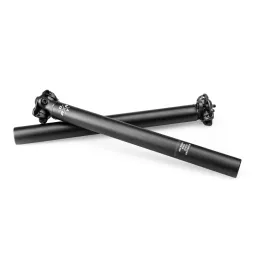
Seatposts differ not only by diameter, but also by saddle mounting system. The main types are standard seatposts, pivotal seatposts and I-beam seatposts. These systems are not interchangeable.
| Seatpost type | For which saddle | Typical use | What to check |
|---|---|---|---|
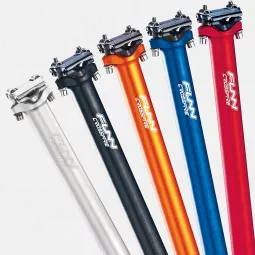
| Standard seatpost | For a classic standard saddle with rails. | MTB, trail, gravel, regular bikes and some BMX/dirt builds. | Seatpost diameter, length, offset and compatibility with a railed saddle. |
| Pivotal seatpost | For a pivotal saddle mounted with one central bolt. | BMX race, BMX freestyle, street, park, dirt and simpler builds. | A pivotal saddle must be used. It is not compatible with a classic railed saddle. |
| I-beam seatpost | For an I-beam saddle without classic rails. | More specific builds depending on the saddle and mounting system. | The seatpost and saddle must use the same I-beam system. |
Seatpost diameter
The seatpost diameter must exactly match the internal diameter of the frame’s seat tube. Always check the size according to the original seatpost, the frame specification or by accurate measurement. In this category, we mainly offer 25.4 mm seatposts, 27.2 mm, 30.9 mm and 31.6 mm, with some options also in 22.2 mm or 26.8 mm depending on the specific frame.
A 25.4 mm seatpost is a common part on BMX and dirt bikes. A 27.2 mm seatpost is often used in the context of gravel or XC bikes. 30.9 mm and 31.6 mm seatposts are common sizes on modern MTB and trail frames.
Seatpost by bike style
On MTB, trail and gravel bikes, standard seatposts for saddles with rails are commonly used. With these bikes, the main factors are diameter, length, saddle position adjustment and sometimes the offset of the seatpost head.
On BMX race, BMX freestyle, street, park and dirt bikes, the pivotal system is very common. A pivotal seatpost is simple, clean and suits builds where the saddle is not primarily used as long-term seated support, but rather as a compact part of the bike setup.
Seatpost length, offset and riding position
Besides diameter, you should also check seatpost length. The seatpost must be long enough for the correct saddle height, but it also has to fit into the frame and remain inserted at least to the marked minimum insertion line. A seatpost that is too short may be unsafe, while one that is too long may not insert correctly into the frame.
On standard seatposts, offset can also matter. Offset means that the saddle clamp is positioned slightly behind the seatpost axis. It affects how far back you sit in relation to the bike’s centre. On MTB, gravel or regular bikes, this can matter for riding position. On BMX, dirt or pivotal systems, saddle position is often approached differently and offset may not be the main deciding factor.
If you want to lower and raise the saddle while riding, it makes sense to look at dropper posts. They are more complex, but in technical terrain they allow you to change saddle height quickly according to the situation.
What to check when choosing a seatpost
- Seatpost diameter: It must exactly match the frame. The most common sizes here are 25.4 mm, 27.2 mm, 30.9 mm and 31.6 mm.
- Saddle mounting type: Standard, pivotal and I-beam are different systems. The saddle and seatpost must be compatible.
- Seatpost length: The seatpost must allow the correct saddle height and safe insertion into the frame.
- Minimum insertion: Never raise the seatpost above the marked minimum insertion line.
- Bike style: MTB, gravel, BMX, dirt or race builds may use different saddle and seatpost systems.
- Offset: On standard seatposts, offset can affect riding position. On pivotal or I-beam systems, this is handled differently according to saddle construction.
In practice: first identify the correct diameter according to the frame, then check the saddle type, and only after that choose the specific seatpost by length, use, material, offset and design.
How do I find the correct seatpost diameter?
You can find the correct seatpost diameter from the original seatpost, the frame specification or by accurately measuring the internal diameter of the seat tube. The diameter must match exactly. A 25.4 mm, 27.2 mm, 30.9 mm or 31.6 mm seatpost always belongs in a frame with the corresponding internal diameter.
What is the difference between a standard, pivotal and I-beam seatpost?
A standard seatpost is designed for a classic saddle with rails. A pivotal seatpost is designed for a pivotal saddle mounted with one central bolt. An I-beam seatpost is designed for an I-beam saddle without classic rails. These systems are not interchangeable.
Can I use a pivotal saddle on a standard seatpost?
No. A pivotal saddle requires a pivotal seatpost. A standard seatpost is designed for saddles with classic rails. If you want to use a pivotal saddle, you need a seatpost with the same mounting system.