

-
Top offers
-
Bikes
-
Accesories

Categories
Availability
Brand
Price
Selections
colour
Saddles
Bike saddles affect comfort, riding position and control of the bike. In this category you will find MTB, BMX, dirt, trail and universal cycling saddles with different mounting systems – from standard railed saddles to pivotal, I-beam and combo/integral saddle-and-seatpost setups.


Bestsellers in this category


Sort by:





How to choose a bike saddle by mounting system, position and riding style
Standard saddles | Pivotal saddles | I-beam saddles | Combo saddles | Width and shape | MTB and BMX use | Compatibility | FAQ
Do not choose a bike saddle only by its look, colour or how soft it feels at first touch. The key factors are the mounting system, seatpost compatibility, width, shape, padding and riding style. A different saddle makes sense for MTB trail riding than for BMX, dirt, freestyle or a simple kids’ bike build.
In this category, you will find saddles for different types of bikes and riding styles – from classic standard railed saddles through pivotal saddles and I-beam saddles to combo / integral saddles, where the saddle and seatpost are built as one unit.
Standard railed saddles: the most universal option
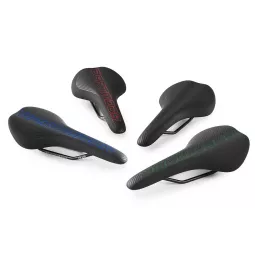
Standard railed saddles are the most common and most universal type of cycling saddle. They use classic saddle rails, which clamp into a standard seatpost head. This makes them suitable for most MTB, gravel, road, city and trekking bikes, as long as you have the correct seatpost for a railed saddle.
The main advantage of the standard system is the wide choice of shapes, widths, materials and padding levels. If you are looking for an MTB saddle, a trail bike saddle, an enduro saddle, a dirt saddle or a straightforward replacement for an old saddle, the standard rail system is usually the easiest place to start. It also allows good fore-aft and tilt adjustment according to your riding position.
Our standard saddle range includes brands such as Dartmoor, SDG USA, DMR Bikes and Gusset, which are more focused on MTB, trail, dirt and enduro use than purely urban comfort saddles. If you are looking for a universal saddle for a mountain bike, standard railed saddles are usually the most logical starting point.
Pivotal saddles: a typical choice for BMX, freestyle and dirt
Pivotal saddles are typical mainly for BMX, freestyle, dirt and some clean-looking simple builds. Unlike classic railed saddles, they are not clamped from the sides. They are mounted using a bolt that goes from the top of the saddle into a pivotal seatpost. The benefit is a clean look, low profile and adjustable saddle angle.
With the pivotal system, compatibility is essential. A pivotal saddle does not fit a standard railed seatpost. If you want to use a pivotal saddle, you need the matching pivotal seatpost. If you are not sure which mounting system you have, check the seatpost first or choose the standard railed system.
With pivotal saddles, it makes sense to look mainly at the shape, profile height, cover durability and whether the saddle is intended for BMX, dirt or freestyle use. In this part of the category, brands such as Dartmoor, Octane One and Odyssey BMX naturally fit the BMX, dirt and freestyle segment.
I-beam saddles: a specific system where the seatpost matters
I-beam saddles use a different mounting system from regular railed saddles. Instead of two classic rails, they use a central beam profile that clamps into a matching I-beam seatpost. This can offer a clean construction and good adjustment, but it is also a less universal system.
The most important rule is simple: an I-beam saddle needs an I-beam seatpost. It cannot be used directly with a standard railed seatpost or a pivotal seatpost. If you are only replacing the saddle and already have a seatpost on the bike, check compatibility before choosing a specific model.
The I-beam system is often associated with SDG USA saddles, which make sense for MTB, dirt, freeride or more aggressive use. The advantage can be a firm mount and clean setup; the downside is a smaller choice of compatible seatposts and less interchangeability compared with the classic standard rail system.
Combo / integral saddles: saddle and seatpost in one unit
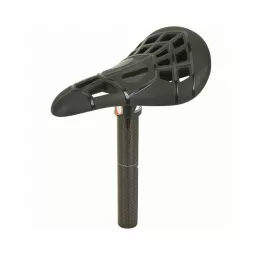
Combo or integral saddles combine the saddle and seatpost into one unit. This solution is used mainly on BMX, kids’ bikes, race BMX, freestyle or simpler builds where low weight, a clean look and simplicity without a separate saddle clamp make sense.
The advantage of a combo saddle is simple installation and fewer separate parts. The downside is less adjustability, and when replacing it, you are not replacing just the saddle or just the seatpost, but the complete unit. That is why you need to check the seatpost diameter, length and overall frame compatibility.
For combo / integral saddles, brands such as BOX Components, Dartmoor and Tioga are worth watching. BOX Components makes sense mainly in a BMX race context, Dartmoor in dirt and freestyle builds, and Tioga in lighter or more performance-oriented variants.
Saddle width, shape and padding
Saddle comfort is not only about softness. The saddle should properly support the sit bones and avoid putting too much pressure on soft tissue. A saddle that is too narrow may create pressure because the sit bones are not supported well enough. A saddle that is too wide can interfere with pedalling, rub the thighs or get in the way when moving around the bike in technical terrain.
A common mistake is assuming that a softer saddle is automatically more comfortable. It may feel good on a short ride, but on longer or sportier rides the rider can sink into overly soft padding, which can distribute pressure worse. For MTB, trail or enduro use, a firmer and better-shaped saddle often works better than an extremely soft comfort saddle.
Some saddles use a central channel or cut-out. This can help reduce pressure in sensitive areas, but it is not a universal solution for everyone. Width, shape, saddle tilt and overall riding position still need to be right. If your saddle causes pain, the problem may not be the saddle alone – it can also be saddle height, tilt or an overly stretched riding position.
MTB, trail, enduro and BMX saddles: same component, different logic
For MTB, trail and enduro saddles, the key is a balance of pedalling comfort, durability and freedom of movement in terrain. The saddle needs to support you on climbs, but it must not get in the way on descents, when moving behind the saddle or when controlling the bike in technical sections. For trail and enduro bikes, a suitable saddle is often paired with a dropper seatpost.
With BMX, dirt and freestyle bikes, the logic is different. The saddle is often not primarily used for long seated pedalling, but more for bike control, style, simplicity and durability. That is why pivotal or combo systems are more common here. For BMX saddles, low profile, clean mounting, durable cover and compatibility with the specific seatpost or frame matter more.
If you are choosing a saddle for MTB, focus mainly on width, shape, padding and how you move on the bike in terrain. If you are choosing a saddle for BMX or dirt, start with the mounting system and compatibility. Brands such as Dartmoor, DMR Bikes, SDG USA and Funn make sense mainly for MTB, trail, dirt and enduro use, while BOX Components, Odyssey BMX, Tioga and Haro Bicycles naturally fit more into BMX, race BMX and freestyle segments.
Saddle, seatpost and seat clamp compatibility
Never choose a saddle separately from the seatpost. If you have a standard seatpost for rails, you need a standard railed saddle. If you have a pivotal seatpost, you need a pivotal saddle. If you use the I-beam system, both the I-beam saddle and the matching seatpost must be compatible. With combo/integral saddles, the seatpost is part of the unit, so diameter and length become the main points to check.
For the seatpost, you need to check the frame-specific diameter, such as 27.2 mm, 30.9 mm or 31.6 mm depending on the bike. For the seat clamp, you are checking the outer diameter of the frame’s seat tube, not the diameter of the seatpost itself. This is a common source of mistakes when choosing parts.
In practice: if you are only replacing the saddle, first check the mounting type on your current seatpost. If you are building a new bike or changing several parts at once, treat the saddle, seatpost and clamp as one system. This helps avoid the situation where the saddle looks right, but mechanically does not fit the bike.
What to check when choosing a saddle
- Mounting system: Standard, pivotal, I-beam and combo/integral are not interchangeable systems. The saddle must match the seatpost or the complete bike setup.
- Saddle width: The saddle should support your sit bones. A saddle that is too narrow can create pressure, while a saddle that is too wide can interfere with pedalling or body movement in terrain.
- Shape and profile: A flatter saddle can suit riders who move around on the saddle more. A more shaped saddle can offer better support, but it needs to match the riding position.
- Padding: A soft saddle is not automatically more comfortable. For sportier riding, MTB and longer routes, a firmer and better-shaped saddle often works better.
- Riding style: An MTB saddle needs to work for pedalling and movement in terrain. A BMX or dirt saddle often focuses more on durability, low profile, style and compatibility than long seated comfort.
- Seatpost and clamp: When replacing parts or building a bike, check not only the saddle, but also the seatpost type, its diameter and the matching seat clamp.
- Design and colour: Colour, such as black, blue or a more visible saddle, can fine-tune the look of the bike. It should not come before compatibility, shape and intended use.
The simplest approach is to start with compatibility. If you have a standard seatpost, choose a standard railed saddle. If you are building a BMX or dirt bike, check whether you need a pivotal or combo system. If you are solving comfort on an MTB, focus mainly on width, shape, padding and riding position – not just whether the saddle is labelled as sporty or comfortable.
What is the difference between standard, pivotal, I-beam and combo saddles?
A standard saddle uses classic rails and fits a regular railed seatpost. A pivotal saddle is mounted with a bolt from above into a pivotal seatpost. An I-beam saddle uses a central beam profile and needs an I-beam seatpost. A combo/integral saddle combines the saddle and seatpost into one unit.
Does every saddle fit every seatpost?
No. The saddle must match the seatpost mounting system. A classic railed saddle does not fit a pivotal seatpost, a pivotal saddle does not fit a standard rail clamp, and an I-beam saddle needs its own seatpost type. With combo saddles, the seatpost is part of the unit, so diameter and length are the main points to check.
How do you choose the right saddle width?
Saddle width should mainly match your sit bone width, riding position and riding style. A sportier MTB position often works with a narrower and firmer saddle, while a more upright position may benefit from wider support. A men’s or women’s label alone is not enough – anatomy and intended use matter more.
Is a softer saddle always more comfortable?
Not always. A softer saddle can feel pleasant on a short ride, but on longer or sportier rides the rider can sink into the padding and pressure may be distributed worse. For MTB, trail, enduro or BMX use, a firmer, more durable and better-shaped saddle often makes more sense than an extremely soft comfort saddle.