

-
Top offers
-
Bikes
-
Helmets & Goggles
-
Accesories


Availability
Brand
Price
Selections
size
colour
Road frames
Road frames are the foundation for building a fast bike for pavement, where low weight, stiffness, aerodynamics, and the right geometry play the biggest role. Compared to more versatile gravel frames, they are primarily focused on efficient power transfer, quick acceleration, and precise handling at higher speed. A modern road frame does not have to mean pure race-only use. Some models today can also handle wider tires, disc brakes, and a more practical all-road setup, which makes them a smart choice for riders who want a fast road bike without locking themselves into just one type of riding.
Sort by:


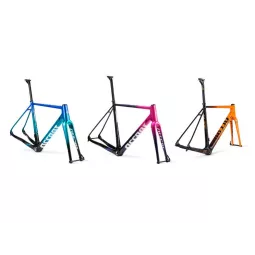


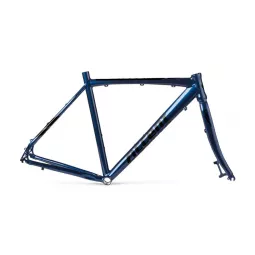

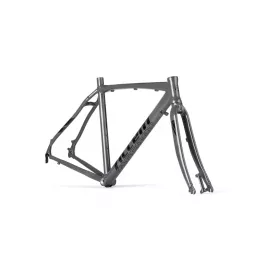

Road Frame: How to Choose a Fast Foundation Without Missing What Really Defines the Bike
Geometry and riding position | Compatibility and standards | Road use with all-road potential
With a road frame, it is not just the material or weight that matters. In real use, it matters just as much whether you want a more aggressive race position or a fast but more manageable frame for longer rides. The frame itself defines how the bike accelerates, holds its line at speed, and how comfortably you can stay on it for several hours at a time.
Road frame vs. gravel frame
A road frame is primarily built for pavement, higher speed, and efficient power transfer. Compared to gravel, it is usually more lively, lower, and more performance-oriented. A gravel frame, on the other hand, typically offers calmer geometry, more tire clearance, and broader use beyond smooth roads.
This is exactly where it makes no sense to think in black-and-white terms. If you want a fast asphalt bike but do not want to be limited to narrow tires and a purely race-focused setup, a frame that sits between road and all-road use can make a lot of sense. In a broader context, this also connects naturally to the Gravel and road category.
What to check so the frame really fits your riding
- Geometry and riding position: Not every road frame is automatically “race-focused.” A more aggressive geometry with a lower front end and a longer position helps with aerodynamics and speed, but it is not ideal for everyone. If you want to ride long distances or do not want an extremely stretched position, a frame with more balanced geometry makes more sense—it can still be fast, but much less tiring.
- Tire clearance: Modern road frames are no longer only about traditional narrow tires. Riders often look at whether the frame can fit 30–32 mm tires or even more, because wider tires can noticeably improve comfort and real-world usability on rougher pavement. If you want a more versatile frame, this is a parameter worth checking from the start.
- Disc brakes and thru-axles: Today this is a very important standard. Disc brakes plus thru-axles mean better braking control, more stiffness, and easier compatibility with modern wheels. If you are building a new bike and do not want to be unnecessarily limited by older standards, this is usually the practical long-term choice.
- Bottom bracket type and future servicing: Riders also often look at whether the frame uses a threaded or pressfit bottom bracket. This is not just a detail for mechanics. It affects future maintenance, noise, and how straightforward the build will be over time. If you want a frame that will still make sense a few years from now, compatibility of standards matters more than it may seem at first glance.
- Material and frame character: Carbon makes sense when you want low weight, stiffness, and quick response. But this is not just a game of chasing grams. What matters is how the frame is designed as a whole and what kind of riding it is meant for. If you are building a fast road bike with some extra versatility, you should look not only at weight, but also at tire clearance, brake standard, and the overall usability of the frame.
- Overall build direction: Start with what you expect from the bike. If you want a pure road setup, stay with a light and responsive build. But if you already know you want more comfort, wider tires, and more margin for real roads, it makes sense to choose a frame that can also move toward all-road use. Only then should you choose the rest of the components, or continue into related categories like forks, frames, and frames and forks.
With Accent, it makes sense to highlight versatility. If you are looking for a frame that can work as a fast road bike but does not lock you into a purely race-focused setup, that is an important advantage. That is exactly why the Accent Cyclone Disc Carbon frameset can be interesting—it is built around a carbon construction, a more aerodynamic concept, and a disc brake standard, while still not feeling limited to just one narrow style of riding.
Workshop insight: With road frames, people often focus mainly on material and size, but in real use it is just as important how aggressive the geometry is and how much room the frame leaves for wider tires. That is what decides whether the final bike will be fast only on perfect asphalt or also practical on real-world roads that are far from ideal.
What is the difference between a road frame and a gravel frame?
A road frame is faster and more performance-oriented on pavement. A gravel frame is usually more versatile, calmer in handling, and designed around wider tires and rougher surfaces.
Does it still make sense to think about wider tires on a road frame?
Yes. More tire clearance gives you more comfort, more confidence, and broader usability. On a modern road bike, this is no longer a minor detail, but an important decision point.
Who does a road frame with all-road potential make sense for?
For riders who want a fast asphalt bike, but do not want to be limited to purely race-focused use. A frame like that gives you more freedom in tire choice, riding style, and future build options.